News / New Massachusetts Cannabis Control Commission Report Reviews Use Among Massachusetts Residents
For Immediate Release
March 13, 2026
Contact
Maryalice Curley
Director of Communications
857-292-4891
Neal McNamara
Press Secretary
857-507-0885
New Massachusetts
Cannabis Control
Commission Report
Reviews Use Among
Massachusetts Residents
International Cannabis Policy Study data estimates how different populations used cannabis between 2018 and 2023
WORCESTER—The Massachusetts Cannabis Control Commission (Commission) has released a new research report measuring recent cannabis use trends in the Commonwealth, revealing that consumers of legal age are overwhelmingly turning away from unregulated sources as the state’s adult-use marijuana industry reaches its eighth year in operation and more than $9 billion in gross sales.
The report is based on data from the International Cannabis Policy Study (ICPS), a quasi-experimental population-based survey that includes responses from more than 11,000 Massachusetts residents ages 16 to 65. The Commission has been using ICPS data to study use trends since 2019, but the new report is the first to evaluate survey responses across five years, 2019 to 2023. The new report is part of the agency’s legislative mandate to research the social and economic impacts of cannabis, including patterns of use, the use of health care services related to cannabis, and criminal penalties related to possession, distribution, and trafficking.
“Tracking this data is part of the Commission’s legislative mandate, but it’s also an important public service to provide Massachusetts residents with valuable insight into who is using cannabis and why,” Chair Shannon O’Brien said. “The Commission will use this information to make policy decisions to uphold our public health and safety mission as the cannabis marketplace continues to grow.”
According to the Commission’s analysis of ICPS data, topline findings among those who reported cannabis use within the past year include:
- Averaged across 2019 to 2023, 61 percent of users of all ages reported buying cannabis at a “store”, including 73% in 2023 (note: the survey did not differentiate between regulated cannabis stores and smoke shops or online retailers that sell hemp-derived THC products that are neither regulated by the Commission nor age-restricted)
- 43 percent reported using cannabis to manage or improve mental health
- 9 percent reported seeking medical help due to adverse reactions from cannabis use
- Average age of first cannabis use rose from 18.5 in 2019 to 19.9 in 2023
- Use frequency generally increased year-over-year for every age group except 16-20, where it dropped from 2019 to 2023
- Use frequency also rose from 37 percent reporting cannabis use in the past 12 months in 2019 to 42.7 percent in 2023
- Smokeable cannabis flower was the most widely used product, with 70 percent reporting using it
- About 14 percent reported driving within two hours of cannabis use, with younger people (16-20) most likely to report driving after use and older adults (56-65) least likely to report driving after use
- 81 percent of respondents in the 2023 survey wave supported adult-use cannabis, a slight drop from the 83 percent support in the 2022 wave
“This new research shows that Massachusetts residents turn away from the illicit market when safe, well-regulated options are available,” Executive Director Travis Ahern said. “We will continue to monitor sources like the ICPS to guide our mission of overseeing an effective, equitable cannabis marketplace in Massachusetts.”
“Our new analysis of ICPS data provides valuable insight into use patterns and the level of education around cannabis use,” Chief of Research Dr. Julie Johnson said. “We are also making recommendations to help strengthen future data analysis and collection, including partnering on future research with other regulators and public health professionals and asking for the initiation of more comprehensive studies assessing cannabis-related impaired driving and health care usage. We also encourage more resources go toward public awareness and youth education, with ample funding available for appropriation through tax revenue generated by cannabis sales.”
The ICPS data is a snapshot of wider trends in cannabis use that have been unfolding since Massachusetts voters began easing marijuana prohibition at the ballot box, first with decriminalization in 2008, then the legalization of medical marijuana in 2012, and ultimately adult-use marijuana legalization in 2016.
The sample of 11,635 respondents in the ICPS survey had a median age of 43.54, was majority white (83.2 percent) and majority female (66 percent). Fourteen percent of the sample identified as students, and 30 percent identified as being in either a difficult or very difficult economic situation. Across all age groups, most respondents reported either never having used cannabis or having used cannabis in the past year or longer.
The study notes that ICPS data is self-reported, which may introduce bias into the results through participants not accurately understanding questions, misunderstanding questions, or intentionally providing misleading answers. Survey results may also be influenced by external factors like municipal-level policies or secular trends occurring at the national level.
Commission studies like the ICPS are initiatives of the Commission’s Center for Cannabis Research and Policy (CCRP). The CCRP offers the Commonwealth an applied cannabis policy research center of excellence, among the first of its kind to both inform evidence-based policy decisions and add to the applied scientific literature. Bringing together legislators, regulators, researchers, and other government agencies to study the implementation and effects of cannabis policies, the center follows an annual research agenda outlined in G. L. c. 94G, § 17(a) and G. L. c. 94G, § 17 (b).
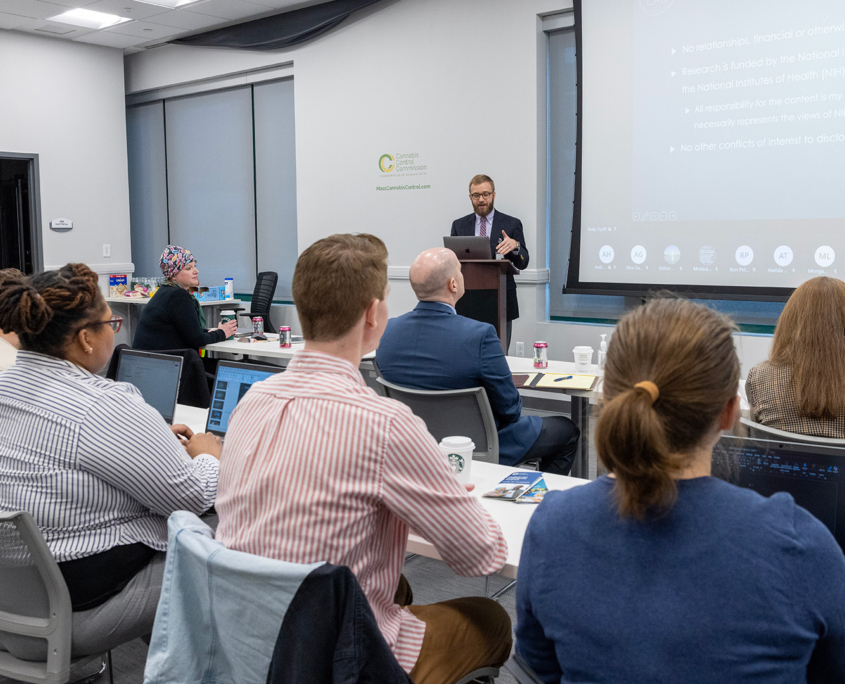
Dr. Andy Hyatt presents “Cannabis, psychosis, and public policy” to Commissioners and staff on Feb. 20 at the agency’s headquarters in Worcester
The CCRP also assesses other topics of interest, such as states’ effectiveness at creating a diverse new industry and rectifying harms from marijuana prohibition and enforcement. The CCRP has focused on merging academia and policy by bringing diverse stakeholders together and publishing for a variety of audiences to advance cannabis policy research. On Feb. 20, for example, the Research Department hosted a psychiatrist from Cambridge Health Alliance and Harvard Medical School, Dr. Andy Hyatt, for a presentation to staff about the effects of public policy on individuals with substance use disorders and severe mental illness as part of a National Institutes of Health (NIH)/National Institute on Drug Abuse (NIDA) grant to assess the impact of cannabis legalization and commercialization, for which Dr. Johnson serves as an in-kind policy advisor.
To learn more about the Commission’s research mandate and agenda, visit MassCannabisControl.com/Research, contact the Commission by phone (774-415-0200) or email (Commission@CCCMass.com), or follow the agency on Facebook, X, and LinkedIn.
###
Get Notified
Subscribe for updates from the Cannabis Control Commission.