State & Local Government / Cannabis Revenue Flow in Massachusetts
Cannabis Revenue Flow in Massachusetts
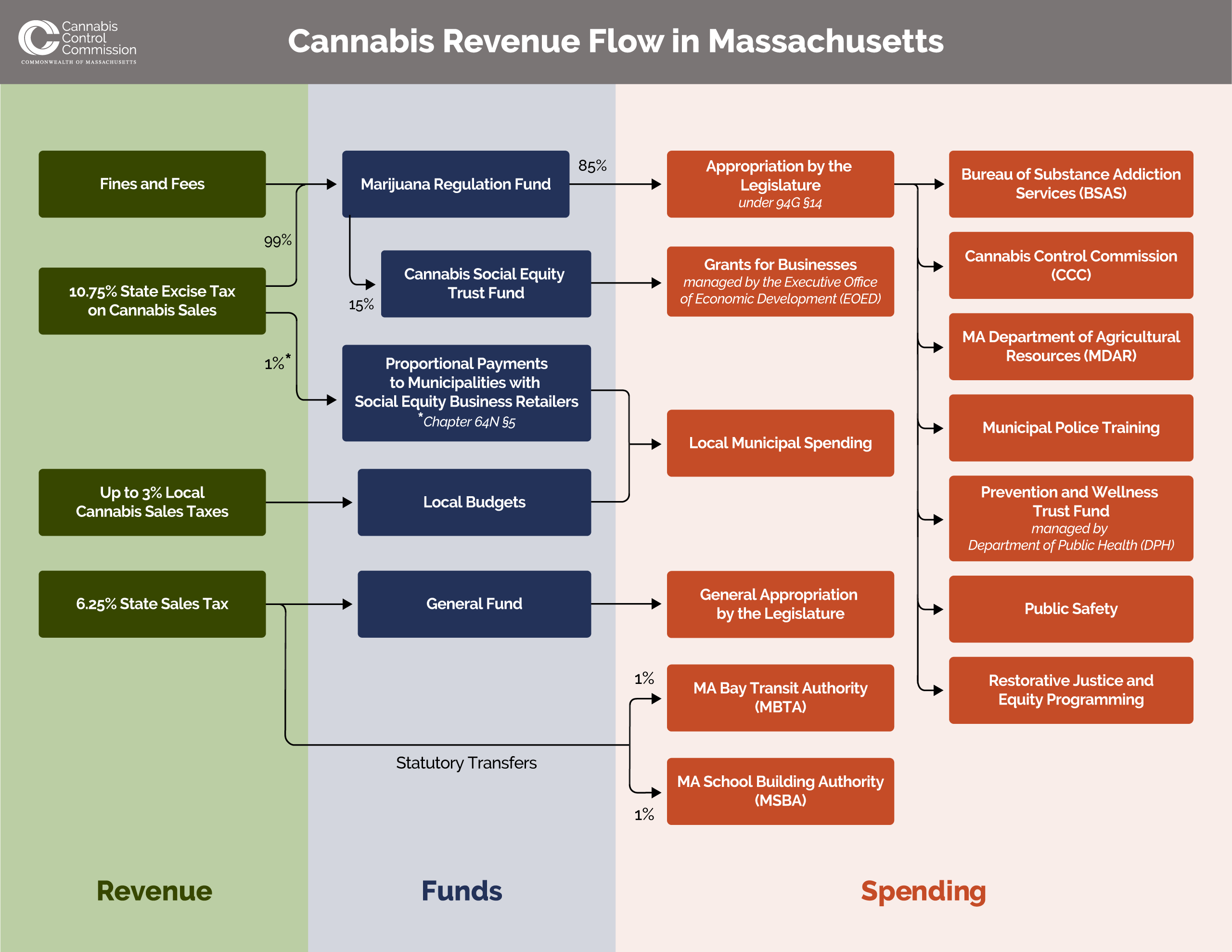
Have you ever wondered where consumers’ tax dollars go when they purchase products from a licensed Marijuana Establishment in Massachusetts? Review this flow chart and guide to find out.
Although the Cannabis Control Commission (Commission) receives a portion of state tax revenue to support agency operations and administration of the Medical Use of Marijuana Program, the agency’s funding is determined annually through the state budget process. The State Legislature and the Governor utilize marijuana tax revenues as a key funding source across many other state government departments, programs, and public services each year. Learn more below or by reviewing Mass. Budget and Policy Center’s 2025 report, Show Me the Money: Cannabis Revenue, Spending, and Equity in Massachusetts.
1
2
3
4
5
6
7
8
9
10
11
12
13
14
15
16
17
18
19
20
1
Fines and Fees: Fines include all civil penalties received for violations of Mass. Gen. Laws. C.94G. Fees include the monetary proceeds the Commonwealth receives through applications for and licensing of Marijuana Establishments via the Commission. Review the Commission’s annual activities reports to the State Legislature for more information on annual fee and fine totals.
2
10.75% State Excise Tax on Cannabis Sales: Under state law, an excise tax of 10.75% is imposed on sales of adult-use marijuana and marijuana products. Medical marijuana sales are tax free. The Department of Revenue (DOR) reports on state tax revenue, versus the industry’s gross sales data that is available through the Commission’s Open Data Platform.
3
Up to 3% Local Cannabis Sales Taxes: A city or town in which a Marijuana Establishment is located, otherwise known as a host community, may impose a tax of up to 3% of adult-use marijuana retail sales in its locality. However, medical marijuana sales are exempt from the local tax option. DOR maintains data on local tax revenue. Learn more about the municipality’s roles and responsibilities as it relates to the cannabis industry in Massachusetts.
4
6.25% State Sales Tax: The standard Massachusetts sales tax of 6.25% is applied to all sales of adult-use marijuana and marijuana products, like other commodities. There is no sales tax applied to medical marijuana sales. DOR maintains data on state tax revenue.
5
Marijuana Regulation Fund (MRF): Revenue generated by the legal Massachusetts cannabis industry through Commission license application fees, fines, and the state excise tax on sales is deposited into the MRF, established under Mass. Gen. Laws. C.94G Section 14. The MRF is required by statute to be used for specified purposes and is allocated through the annual state budget process. The Massachusetts Office of the Comptroller reports on the MRF and provides a breakdown of each revenue source. Read more about where the money is required to go under “spending” below.
6
Cannabis Social Equity Trust Fund (CSETF): The CSETF was established under Chapter 180 of the Acts of 2022, An Act Relative to Equity in the Cannabis Industry. The fund offers grants and no-interest or forgivable loans to eligible businesses that participate in the Commission’s equity programming. The CSETF is supported by funds from private sources (gifts, grants, donations) and 15% of revenue from the MRF on an annual basis. The CSETF is administered by the Executive Office of Economic Development (EOED) under the Governor’s Office, in consultation with the Cannabis Social Equity Advisory Board.
7
Proportional Payments to Municipalities with Social Equity Business Retailers: A portion of the state excise tax on regulated adult-use cannabis sales is returned to municipalities. Cities and towns that host at least one social equity Marijuana Retailer receive quarterly payments equal to 1% of total sales from these retailers. Each municipality’s payment is proportional to the amount of social equity retail sales occurring within its borders, meaning higher local sales result in a larger share of the distribution.
8
Local Budgets: Any revenue generated by the optional local cannabis sales tax imposed by a host community goes directly to the local budget of that municipality to spend at their discretion. To see which towns impose the tax, visit the Department of Revenue’s Local Tax Options page.
9
General Fund: Similar to other state commodities, the 6.25% sales tax on cannabis products goes directly to the Massachusetts General Fund, the Commonwealth’s main operating fund, which is allocated through the state budget process each year by the State Legislature and Governor. Under state law, set portions of sales tax revenue is required to directly fund and support the Massachusetts Bay Transit Authority (MBTA) and the Massachusetts School Building Authority (MSBA).
10
Marijuana Relief Fund (MRF) – Appropriation by the Legislature: Eighty-five percent of the revenue from the MRF is appropriated by the State Legislature and Governor annually through the state budget process. According to current state law, in addition to the Commission’s operations and administration of the Medical Use of Marijuana Program, funds may be allocated towards the following state agencies and priorities:
11
Cannabis Social Equity Trust Fund (CSETF) – Grants for Businesses: Prior to appropriation of the MRF, fifteen percent of the revenue is allocated to the CSETF which provides grants and low- or no-interest loans to participants of the Commission’s equity programs. The fund is also supported by gifts and donations and is administered by EOED. Review previous grant awards through annual reports available on EOED’s website.
12
Proportional Payments to Municipalities and Local Budgets – Local Municipal Spending: Cities and towns that are host communities to retailers with majority ownership from Social Equity or Economic Empowerment individuals receive a portion of the revenue generated by the state excise tax on cannabis sales. Cities and towns may also implement a local option sales tax of up to 3% on retail sales of cannabis products. These funds are allocated to a municipalities general fund and then appropriated by the municipality in their budget. Municipal budgets fund essential public services such as education, public works (roads, waste management, sewer, water), culture and recreation, public safety (police and fire protection), and more.
13
General Fund – Appropriation by the Legislature: All revenue generated from the Massachusetts state sales tax, including taxes on marijuana and marijuana products, is deposited into the Massachusetts General Fund, which is then appropriated by the State Legislature and Governor annually.
14
State Sales Tax Statutory Transfers – Massachusetts Bay Transit Authority (MBTA): Under state law, a mandatory transfer is made from all state sales tax revenue to the MBTA, the largest transit system in the Commonwealth, which provides subway, bus, commuter rail, ferry, and paratransit service to eastern Massachusetts and parts of Rhode Island.
15
State Sales Tax Statutory Transfers – Massachusetts School Building Authority (MSBA): Under state law, a mandatory transfer is also made from all state sales tax revenue to the MSBA, a quasi-independent government authority that helps fund the construction of school buildings in the Commonwealth.
16
Bureau of Substance Addiction Services (BSAS): BSAS, managed by the Department of Public Health (DPH), oversees the statewide system of prevention, intervention, treatment, and recovery support services for individuals, families, and communities affected by substance addiction. To learn more about what types of support services are funded in this section, please see the Commonwealth’s Annual Budget.
17
Massachusetts Department of Agricultural Resources (MDAR): MDAR supports, regulates, protects and enhances the Commonwealth’s agricultural community by enforcing economically and environmentally sound food safety and animal health policies, as well as preserving farmland, providing technical assistance to help farms become more energy efficient, and promoting “MassGrown” crops and products.
18
Municipal Police Training: Funds from the MRF may be allocated through multiple budget line items to support the development and delivery of training materials and activities for police officers.
19
Prevention and Wellness Trust Fund: The Prevention and Wellness Trust Fund, managed by DPH, focuses on reducing rates of the most prevalent and preventable health conditions; increasing healthy behaviors; increasing the adoption of workplace-based wellness or health management programs that result in positive returns on investment for employees and employers; addressing health disparities; and developing a stronger evidence-base of effective prevention programming.
20
Public Safety and Restorative Justice and Equity Programming: Each year, MRF funding may be allocated towards programming for restorative justice, jail diversion, workforce development, technical assistance, and mentoring services for economically- disadvantaged persons in communities disproportionately impacted by high rates of arrest and incarceration for marijuana offenses. For example, in previous years, funds have been designated for community-based re-entry programs to reduce recidivism. To learn more about what types of programming and services are funded in this section, please see the Commonwealth’s Annual Budget.
Revenue
Fines and Fees: Fines include all civil penalties received for violations of Mass. Gen. Laws. C.94G. Fees include the monetary proceeds the Commonwealth receives through applications for and licensing of Marijuana Establishments via the Commission. Review the Commission’s annual activities reports to the State Legislature for more information on annual fee and fine totals.
10.75% State Excise Tax on Cannabis Sales: Under state law, an excise tax of 10.75% is imposed on sales of adult-use marijuana and marijuana products. Medical marijuana sales are tax free. The Department of Revenue (DOR) reports on state tax revenue, versus the industry’s gross sales data that is available through the Commission’s Open Data Platform.
Up to 3% Local Cannabis Sales Taxes: A city or town in which a Marijuana Establishment is located, otherwise known as a host community, may impose a tax of up to 3% of adult-use marijuana retail sales in its locality. However, medical marijuana sales are exempt from the local tax option. DOR maintains data on local tax revenue. Learn more about the municipality’s roles and responsibilities as it relates to the cannabis industry in Massachusetts.
6.25% State Sales Tax: The standard Massachusetts sales tax of 6.25% is applied to all sales of adult-use marijuana and marijuana products, like other commodities. There is no sales tax applied to medical marijuana sales. DOR maintains data on state tax revenue.
Funds
Marijuana Regulation Fund (MRF): Revenue generated by the legal Massachusetts cannabis industry through Commission license application fees, fines, and the state excise tax on sales is deposited into the MRF, established under Mass. Gen. Laws. C.94G Section 14. The MRF is required by statute to be used for specified purposes and is allocated through the annual state budget process. The Massachusetts Office of the Comptroller reports on the MRF and provides a breakdown of each revenue source. Read more about where the money is required to go under “spending” below.
Cannabis Social Equity Trust Fund (CSETF): The CSETF was established under Chapter 180 of the Acts of 2022, An Act Relative to Equity in the Cannabis Industry. The fund offers grants and no-interest or forgivable loans to eligible businesses that participate in the Commission’s equity programming. The CSETF is supported by funds from private sources (gifts, grants, donations) and 15% of revenue from the MRF on an annual basis. The CSETF is administered by the Executive Office of Economic Development (EOED) under the Governor’s Office, in consultation with the Cannabis Social Equity Advisory Board.
Proportional Payments to Municipalities with Social Equity Business Retailers: A portion of the state excise tax on regulated adult-use cannabis sales is returned to municipalities. Cities and towns that host at least one social equity Marijuana Retailer receive quarterly payments equal to 1% of total sales from these retailers. Each municipality’s payment is proportional to the amount of social equity retail sales occurring within its borders, meaning higher local sales result in a larger share of the distribution.
Local Budgets: Any revenue generated by the optional local cannabis sales tax imposed by a host community goes directly to the local budget of that municipality to spend at their discretion. To see which towns impose the tax, visit the Department of Revenue’s Local Tax Options page.
General Fund: Similar to other state commodities, the 6.25% sales tax on cannabis products goes directly to the Massachusetts General Fund, the Commonwealth’s main operating fund, which is allocated through the state budget process each year by the State Legislature and Governor. Under state law, set portions of sales tax revenue is required to directly fund and support the Massachusetts Bay Transit Authority (MBTA) and the Massachusetts School Building Authority (MSBA).
Spending
MRF – Appropriation by the Legislature: Eighty-five percent of the revenue from the MRF is appropriated by the State Legislature and Governor annually through the state budget process. According to current state law, in addition to the Commission’s operations and administration of the Medical Use of Marijuana Program, funds may be allocated towards the following state agencies and priorities:
- Bureau of Substance Addiction Services (BSAS): BSAS, managed by the Department of Public Health (DPH), oversees the statewide system of prevention, intervention, treatment, and recovery support services for individuals, families, and communities affected by substance addiction. To learn more about what types of support services are funded in this section, please see the Commonwealth’s Annual Budget.
- Massachusetts Department of Agricultural Resources (MDAR): MDAR supports, regulates, protects and enhances the Commonwealth’s agricultural community by enforcing economically and environmentally sound food safety and animal health policies, as well as preserving farmland, providing technical assistance to help farms become more energy efficient, and promoting “MassGrown” crops and products.
- Municipal Police Training: Funds from the MRF may be allocated through multiple budget line items to support the development and delivery of training materials and activities for police officers.
- Prevention and Wellness Trust Fund: The Prevention and Wellness Trust Fund, managed by DPH, focuses on reducing rates of the most prevalent and preventable health conditions; increasing healthy behaviors; increasing the adoption of workplace-based wellness or health management programs that result in positive returns on investment for employees and employers; addressing health disparities; and developing a stronger evidence-base of effective prevention programming.
- Public Safety and Restorative Justice and Equity Programming: Each year, MRF funding may be allocated towards programming for restorative justice, jail diversion, workforce development, technical assistance, and mentoring services for economically- disadvantaged persons in communities disproportionately impacted by high rates of arrest and incarceration for marijuana offenses. For example, in previous years, funds have been designated for community-based re-entry programs to reduce recidivism. To learn more about what types of programming and services are funded in this section, please see the Commonwealth’s Annual Budget.
CSETF – Grants for Businesses: Prior to appropriation of the MRF, fifteen percent of the revenue is allocated to the CSETF which provides grants and low- or no-interest loans to participants of the Commission’s equity programs. The fund is also supported by gifts and donations and is administered by EOED. Review previous grant awards through annual reports available on EOED’s website.
Proportional Payments to Municipalities and Local Budgets – Local Municipal Spending: Cities and towns that are host communities to retailers with majority ownership from Social Equity or Economic Empowerment individuals receive a portion of the revenue generated by the state excise tax on cannabis sales. Cities and towns may also implement a local option sales tax of up to 3% on retail sales of cannabis products. These funds are allocated to a municipalities general fund and then appropriated by the municipality in their budget. Municipal budgets fund essential public services such as education, public works (roads, waste management, sewer, water), culture and recreation, public safety (police and fire protection), and more.
General Fund – Appropriation by the Legislature: All revenue generated from the Massachusetts state sales tax, including taxes on marijuana and marijuana products, is deposited into the Massachusetts General Fund, which is then appropriated by the State Legislature and Governor annually.
State Sales Tax Statutory Transfers – Massachusetts Bay Transit Authority (MBTA): Under state law, a mandatory transfer is made from all state sales tax revenue to the MBTA, the largest transit system in the Commonwealth, which provides subway, bus, commuter rail, ferry, and paratransit service to eastern Massachusetts and parts of Rhode Island.
State Sales Tax Statutory Transfers – Massachusetts School Building Authority (MSBA): Under state law, a mandatory transfer is also made from all state sales tax revenue to the MSBA, a quasi-independent government authority that helps fund the construction of school buildings in the Commonwealth.
Attend a Public
Meeting
The Cannabis Control Commission conducts
meetings and other events to keep you informed.
Subscribe to Our
Notice List
Sign up for updates from the
Cannabis Control Commission.
Attend a Public
Meeting
The Cannabis Control Commission conducts meetings and other events to keep you informed.
Subscribe to Our
Notice List
Sign up for updates from the Cannabis Control Commission.